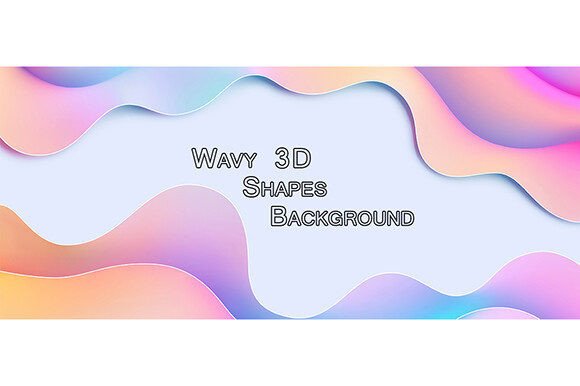
Wavy 3D Shapes Background
Visual design is rarely just about what you see; it is about how that visual information feels. When you are crafting a brand identity, designing a website header, or preparing marketing materials, the background often plays the most critical role in setting the tone before a viewer even reads your headline. This is where a Wavy 3D Shapes Background becomes an invaluable asset. Unlike flat, static patterns, wavy three-dimensional forms introduce depth, movement, and organic flow to a composition. They guide the eye, create interest without overwhelming the content, and add a layer of sophistication that simple gradients or solid colors often lack.
However, not all backgrounds are created equal. Many creators download low-quality assets that look pixelated on high-resolution screens or clash with their typography due to poor contrast. Understanding the nuances of using high-fidelity abstract backgrounds can mean the difference between a professional, polished look and a amateurish presentation. The specific asset described here—a 4807x2100 px resolution file at 300 DPI in JPEG format—offers a robust foundation for various applications, but its success depends entirely on how you evaluate and implement it.
Evaluating Resolution and Print Readiness
One of the most common mistakes designers make is assuming that a digital image is suitable for print simply because it looks good on a monitor. A Wavy 3D Shapes Background might appear smooth on a laptop screen, but when scaled up for a poster, packaging, or large-format banner, any lack of detail becomes glaringly obvious. This is why checking the technical specifications is non-negotiable.
The specification of 4807 pixels by 2100 pixels provides a wide aspect ratio, ideal for headers, web banners, and panoramic displays. More importantly, the 300 DPI (dots per inch) rating confirms that this is a print-ready file. For those unfamiliar, DPI refers to the density of printed dots. Standard web images are typically 72 DPI, which results in blurry, jagged edges when printed. By ensuring your source file is 300 DPI, you guarantee crisp edges and smooth color transitions, whether you are printing business cards, postcards, or wall art.
If you are planning to use this background for physical products like notebooks or packaging, always request a proof or a small-scale test print first. Colors can shift slightly between RGB (screen) and CMYK (print) modes. While a high-quality JPEG retains vibrant colors, understanding this limitation helps you avoid costly reprints if the final output looks duller than expected on screen.
Avoiding Visual Clutter and Content Overlap
Abstract designs with 3D shapes are visually stimulating, which is their greatest strength and their biggest pitfall. A frequent error occurs when creators place heavy text or complex logos directly over areas of high visual activity. If the wavy shapes have strong shadows, highlights, or contrasting colors in the center of the frame, your message may become unreadable.
To avoid this, treat the background as a supporting actor, not the lead. Before applying text, analyze the distribution of light and dark areas in the Wavy 3D Shapes Background. Look for "negative space"—areas where the shapes are softer, lighter, or more uniform. These are your safe zones for headlines and calls to action. If your design requires text across the entire width, consider adding a subtle overlay, such as a semi-transparent white or black layer, to reduce the contrast between the background and the text. This technique ensures legibility while preserving the aesthetic appeal of the underlying 3D forms.
Another consideration is the direction of the waves. Human eyes naturally follow lines and curves. If the wavy shapes lead directly into your logo or primary text, they can subconsciously draw attention to that element. Conversely, if the waves curve away from your key message, they might distract the viewer. Aligning the flow of the background with your layout hierarchy can significantly improve user experience and communication efficiency.
Application-Specific Best Practices
Different mediums require different approaches to the same asset. A one-size-fits-all strategy rarely works when dealing with versatile files like this. Here is how to adapt the Wavy 3D Shapes Background for various uses:
- Websites and Blogs: For web use, the 4807x2100 px size is excellent for hero sections. However, ensure you optimize the file size for faster loading times without sacrificing visible quality. Use modern compression tools to reduce the byte count while maintaining the 300 DPI integrity for retina displays.
- Social Media Branding: When cropping this wide image for square formats like Instagram posts or LinkedIn covers, be mindful of the focal point. Since the original is panoramic, important elements (like a logo or central wave peak) should be centered so they remain visible after cropping. Avoid placing critical details near the extreme left or right edges, as these will likely be cut off.
- Packaging and Postcards: The 300 DPI resolution makes this file ideal for direct mail and product packaging. Ensure that any bleeds required by your printer (usually 0.125 inches on each side) are accounted for. Do not place vital text or logos too close to the edge, as cutting errors during production could slice through your design.
- Wall Art and Decor: For large prints, the high resolution ensures that the 3D effect remains convincing from a distance. However, check the lighting conditions where the art will hang. Glossy finishes on printed wavy shapes can create glare under bright lights, potentially obscuring the details. Matte or satin finishes often preserve the subtlety of the 3D shading better in well-lit environments.
Color Harmony and Emotional Impact
The emotional resonance of a Wavy 3D Shapes Background is heavily influenced by its color palette. Wavy forms often evoke feelings of fluidity, calm, or dynamic energy, depending on the hues used. Cool tones like blues and greens tend to soothe and suggest trust, making them suitable for corporate websites, financial apps, or healthcare branding. Warm tones like oranges, reds, and yellows can stimulate excitement and urgency, which might be appropriate for sale announcements, entertainment events, or creative portfolios.
A common mistake is ignoring the psychological impact of color contrast. If the background features high-contrast colors (e.g., bright yellow against deep purple), it creates a sense of vibration that can be fatiguing to read. For long-form content like blog articles, opt for backgrounds with lower saturation or monochromatic schemes. This allows the reader to focus on the text without visual strain. Always test your chosen color scheme against your brand guidelines to ensure consistency across all touchpoints.
Final Checks Before Implementation
Before finalizing your project, take a moment to review the following checklist:
- Resolution Verification: Confirm the file is indeed 300 DPI and meets the minimum pixel dimensions for your intended output size.
- Contrast Check: Ensure there is sufficient contrast between your foreground elements (text, logos) and the background to maintain readability.
- Cropping Safety: If adapting for different aspect ratios, verify that no essential parts of the design are lost in the crop.
- Format Compatibility: While JPEG is widely supported, ensure it meets the requirements of your printing service or web platform. Some advanced workflows may prefer PNG for transparency, though this specific file is a solid JPEG background.
By approaching the Wavy 3D Shapes Background with these practical considerations in mind, you transform a simple image file into a powerful tool for communication. It is not just about having a pretty picture; it is about leveraging high-quality assets strategically to enhance your message, engage your audience, and present a cohesive, professional brand image. Whether you are a seasoned graphic designer or a small business owner handling your own marketing, paying attention to these details will elevate your work and help you avoid common pitfalls that compromise quality and effectiveness.